
Calendar : May 2026
WORLD DAY OF LIGHT
|
💡 WORLD DAY OF LIGHT May 16 · Every year Full journalistic review · SEO Optimized |
|
📅 Date May 16 |
🏛 Organism UNESCO |
📖 From 2018 |
⏱ Reading ≈ 8 min |
📋 Table of Contents
▸ 1. What is World Day of Light?
▸ 2. History and Origin
▸ 3. The Laser and Theodore Maiman
▸ 4. Light in Science and Technology
▸ 5. Quantum Light: 2025-2026 Edition
▸ 6. Environmental Impact and Light Pollution
▸ 7. Light in Culture and Art
▸ 8. How to Celebrate the International Day of Light
▸ 9. References and Images
▸ 10. Advanced SEO Tab
1. What is World Day of Light?
On 16 May each year, the world celebrates the International Day of Light (ILD), a commemoration proclaimed by UNESCO through 39 C/Resolution 16 with the aim of highlighting the fundamental role that light – and the technologies based on it – plays in science, culture, education and the sustainable development of humanity.
"From the origin of the universe to all kinds of new technologies, from X-rays to radio waves, light shapes our world and understanding it enables the greatest scientific and technological advances." — Audrey Azoulay, Director-General of UNESCO, 2019
The celebration is not merely symbolic. Every May 16, optical institutes, universities, cultural centers and civil organizations around the world carry out activities to bring light science closer to the public: photographic exhibitions, conferences, competitions, artistic lighting of emblematic buildings and much more.
2. History and Origin
The idea was born as a direct consequence of the International Year of Light and Light-Based Technologies, celebrated in 2015. That year brought together thousands of scientists, institutions and leaders of the photonic sector, generating a network of collaboration that needed to be sustained. To preserve this momentum, the scientific community proposed to UNESCO the creation of an annual commemoration date.
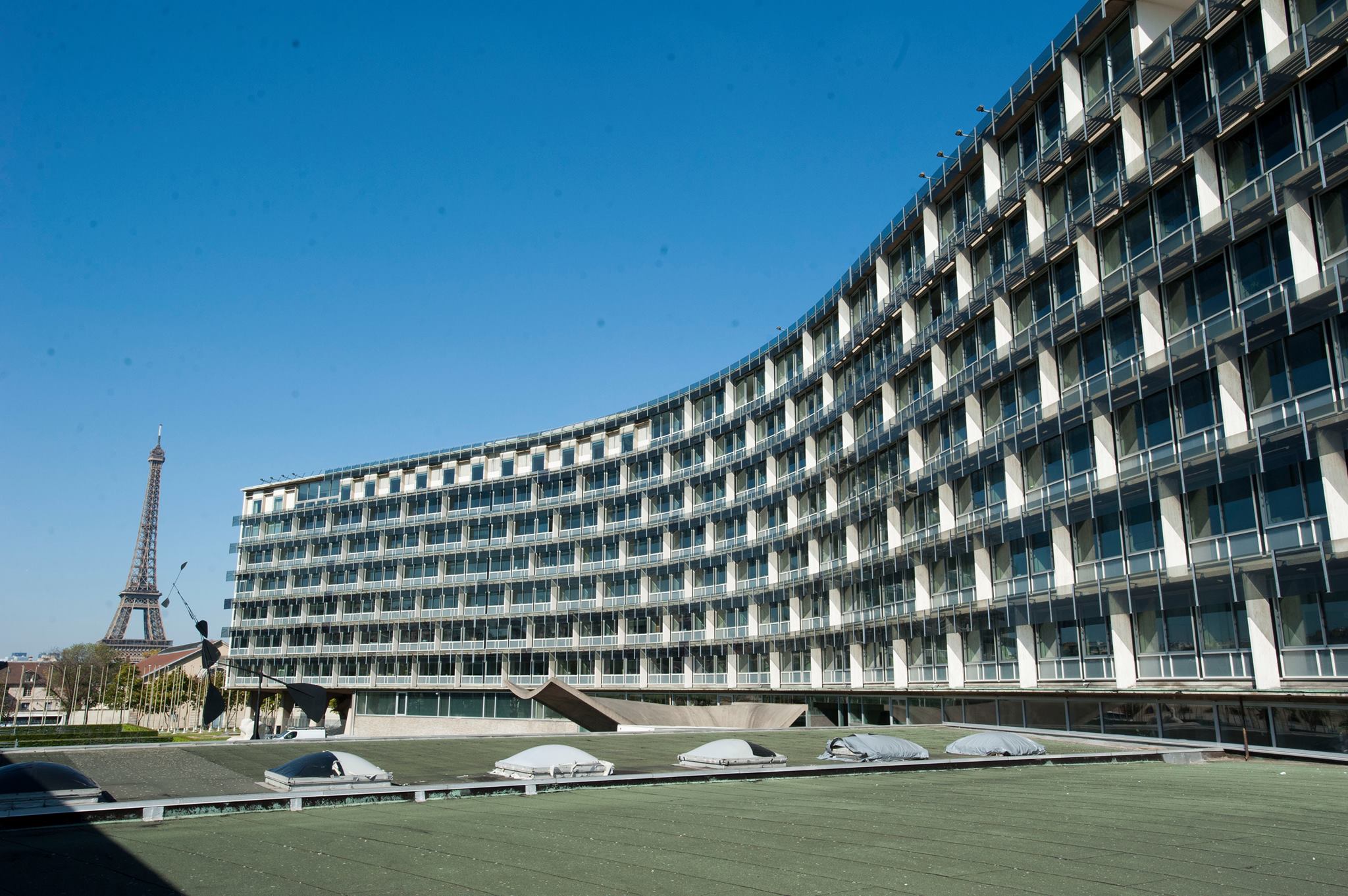
On 30 August 2017, during UNESCO's 39th General Conference, 16 May was officially proclaimed as the International Day of Light. The first official celebration took place on 16 May 2018, with an opening ceremony at UNESCO Headquarters in Paris, France.
🖼 UNESCO Building Paris — UNESCO Headquarters — Paris, France (Wikimedia Commons)
Timeline
▸ 1015 — Ibn Al-Haytham publishes the 'Book of Optics', a seminal work on the nature of light.
▸ 1905 — Albert Einstein formulates the photoelectric effect and the theory of special relativity.
▸ 1960 — Theodore Maiman activates the first functional laser on May 16.
▸ 2015 — The UN declares the International Year of Light.
▸ 2017 — UNESCO proclaims May 16 as the International Day of Light.
▸ 2018 — First official global celebration.
▸ 2025 — International Year of Quantum Science and Technology: 'Quantum Light, a visual odyssey'.
▸ 2026 — Today's celebration: global consolidation of the DIL.
3. The Laser and Theodore Maiman
The date of May 16 is not arbitrary. It commemorates the anniversary of the first successful operation of a laser (Light Amplification by Stimulated Emission of Radiation), carried out by the American physicist and engineer Theodore Harold Maiman in 1960. That event marked a before and after in the history of technology.
Maiman used a synthetic ruby crystal irradiated by a flash lamp to produce a coherent, monochromatic, and highly directional beam of light—the first laser in history. His discovery, initially underestimated by the scientific community, ended up revolutionizing fields as diverse as medicine, telecommunications, industrial manufacturing, and basic research.
Key fact: Maiman's work was based on Albert Einstein's theory of stimulated emission, formulated in 1917. It took 43 years for someone to materialize it into a functional device.
4. Light in Science and Technology
Photonics – the science and technology of photons – is today one of the fastest growing fields in applied research. Its ramifications span virtually every strategic industry of the 21st century.
🏥 Medicine and Diagnostics
Light-based advances have transformed modern medicine. Diagnostic imaging technologies—optical coherence tomography (OCT), fiber-optic endoscopy, confocal microscopy—make it possible to detect diseases non-invasively with unprecedented accuracy. Photodynamic cancer therapy, laser eye surgery, and dermatological treatments are direct clinical applications of photonics.
🌐 Telecommunications and Internet
Fiber optics, which transmit data at close to the speed of light using light pulses, is the backbone of the global internet. Without it, high-definition video streaming, video conferencing, e-commerce, and cloud computing as we know them would be impossible. Today, more than 95% of international data traffic travels over submarine fiber optic cables.
☀️ Solar Energy and Sustainability
The conversion of sunlight into electricity through photovoltaic cells represents one of humanity's strongest bets to combat climate change. Global installed solar capacity now exceeds 1,600 GW (2024), with annual growth rates of 30%. Photonics also optimizes the design of next-generation solar panels, including perovskite cells.
⚛️ Quantum Computing and Photonics
Photons, elementary particles of light, are prime candidates for qubits—units of quantum information—because of their ability to travel long distances without loss of coherence. Quantum photonic computing promises to revolutionize cryptography, artificial intelligence, and the simulation of complex molecular systems.
🖼 Lighted fiber optic cable — Fiber optics — key technology of modern communications (Wikimedia Commons)

5. Quantum Light: The 2025-2026 Edition
The United Nations proclaimed 2025 as the International Year of Quantum Science and Technology (CIS). In this context, UNESCO and its partners launched 'Quantum Light: A Visual Odyssey', a global call for visual works – photographs, illustrations, comics, collages – inspired by the intersection of light and quantum mechanics.
This initiative recognizes that light was the gateway to the quantum world: from the glow of hot bodies that led Max Planck to formulate the quantization of energy in 1900, to the quantum entanglement of photons that today opens the way to absolutely secure communication networks.
In 2026, the International Day of Light is celebrated today: May 16. A reminder that science advances one photon at a time.
6. Environmental Impact and Light Pollution
Paradoxically, light can also be an environmental threat when used improperly. Light pollution—excessive or misdirected artificial lighting—affects ecosystems, alters the circadian cycles of wildlife, disorients migratory birds, and pollutes the night skies, depriving millions of people of the view of the Milky Way.
The International Day of Light is also a platform to raise awareness about the efficient and responsible use of artificial lighting. UNESCO urges Member States to adopt energy-efficient LED technologies, directional lighting and dark-sky protection standards, which are critical for astronomy, scientific tourism and night-time biodiversity.
▸ 83% of the world's population and 99% of Europe and the US live under light-polluted skies (Science Advances, 2016).
▸ State-of-the-art LEDs consume up to 80% less energy than incandescent bulbs.
▸ Public lighting represents between 30% and 50% of the electricity consumption of many municipalities.
▸ Initiatives such as the Starlight Destination Network promote the protection of dark skies in tourist areas.
7. Light in Culture and Art
Light is not just a physical phenomenon: it is the raw material of art, architecture, photography and cinema. The Impressionists based their entire aesthetic revolution on capturing the effects of natural light on the perception of color. Contemporary architecture – from Gothic cathedrals to glass skyscrapers – is designed in permanent dialogue with sunlight.
The Paseo del Prado and the Buen Retiro in Madrid, recognised as 'Landscape of Arts and Sciences' and declared UNESCO World Heritage Sites under the name 'Landscape of Light', illustrate how light can be the backbone of an urban and cultural identity.
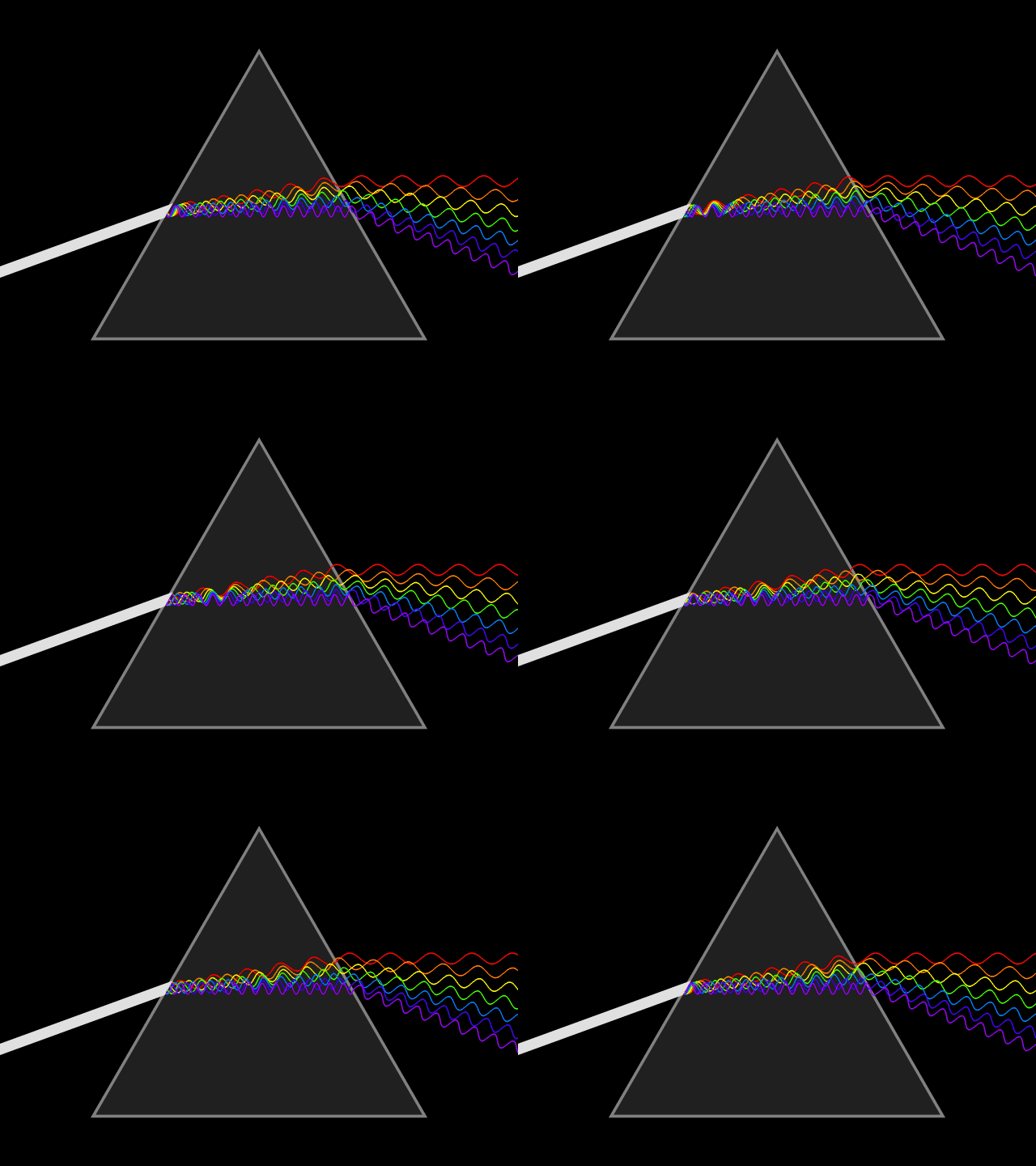
🖼 Scattering of white light in prism — Light prism — refraction of the visible spectrum (Wikimedia Commons)
8. How to Celebrate the International Day of Light
Citizen participation is central to the spirit of the DIL. Here are the main ways to get involved:
▸ 🌐 Follow official events on lightday.org and on the UNESCO site.
▸ 📸 Participate in photo competitions organised by universities and optical institutes.
▸ 💡 Post on social networks with the hashtags #DíaInternacionaldelaLuz #LightDay2026 #LuzCuántica.
▸ 🔭 Join astronomy and dark sky observation activities.
▸ 🏫 Organize talks or experiments on optics in schools and educational centers.
▸ ☀️ Reflect on one's own electricity consumption and adopt efficient LED lighting.
▸ 🎨 Visit light art or scientific photography exhibitions.
9. References and Images
Primary sources and verified resources for further information:
▸ Official UNESCO Site — International Day of Light
▸ United Nations — International Observances
▸ Official website of the International Day of Light
▸ Wikipedia — International Day of Light
▸ Portal diadelaluz.es (Spain)
▸ Creative Commons Images — Wikimedia Commons
💡 May light always illuminate the path of knowledge 💡
Review generated on May 16, 2026 · Sources: UNESCO · UN · Wikipedia · diadelaluz.es
INTERNATIONAL DAY OF THE LIVING TOGETHER IN PEACE
|
🕊️ MAY 🕊️ 16 INTERNATIONAL DAY OF THE LIVING TOGETHER IN PEACE "Building trust through dialogue, inclusion and reconciliation" Theme 2026 · United Nations |
|
📅 May 16, 2026 |
⏱️ Read: ~9 minutes |
🌐 UN Resolution A/RES/72/130 |
|
🔍 SEO METADATA Title tag: International Day of Living Together in Peace 2026 | Origin, Theme and How to Celebrate Meta description: All about May 16: history, UN theme 2026, activities and how to promote peaceful coexistence in your community. Primary keywords: International Day of Living Together in Peace, May 16 UN, living together in peace 2026 LSI / semantic keywords: tolerance, inclusion, resolution 72/130, culture of peace, intercultural dialogue, 2030 Agenda, SDG 16, UNESCO peace Slug canonical URL: /international-day-living-in-peace Schema.org: Article + Event + BreadcrumbList + FAQPage Hashtags: #ConvivenciaEnPaz #16Mayo #LivingTogetherInPeace #ONU2026 #CulturasDePaz #ODS16 #UNESCO |
🌍 The world we want: living together in peace
Every May 16, the international community stops its hectic march and asks itself the oldest and most urgent question of humanity: how to live together in a diverse world, marked by differences of language, faith, culture and opinion? The International Day of Living Together in Peace, proclaimed by the General Assembly of the United Nations, is the institutional answer to this question. It is not just a day of remembrance: it is a global call to action.
In 2026, when the planet is going through a juncture of political polarization, persistent armed conflicts, and hate speech in digital expansion, the date takes on unprecedented relevance. The theme chosen by the UN for this year, "Building trust through dialogue, inclusion and reconciliation", underlines that peace is not a static condition, but a daily, human and collective process.
|
🖼 United Nations Headquarters — General Assembly, New York The UN General Assembly proclaimed May 16 through Resolution 72/130 of December 8, 2017. Source: UN |

📜 History and origin of the date
The roots of this day go back to the darkest period of the 20th century. After the devastation of World War II, the founders of the United Nations drafted the San Francisco Charter (1945) with a central purpose: to save succeeding generations from the scourge of war. However, the following decades have shown that the absence of armed conflict does not equate to true peace.
The path to this day began with successive milestones within the UN system:
|
Year |
Historical milestone |
Institutional framework |
|
1945 |
United Nations Foundation |
Letter from San Francisco |
|
1997 |
Year 2000 declared International Year for the Culture of Peace |
Resolution AG 52/15 |
|
1999 |
Declaration and Programme of Action on the Culture of Peace |
Resolution AG 53/243 |
|
1998–2010 |
International Decade for the Culture of Peace and Non-Violence for Children |
Resolution AG 53/25 |
|
2017 |
Proclamation of May 16 as the International Day of Living Together in Peace |
Resolution A/RES/72/130 |
|
2018 |
First official celebration of the day |
UN · UNESCO · AISA |
|
2020 |
Theme: "Living Better Together" — Call for a Global COVID-19 Ceasefire |
Message from the President AG 74th Session |
|
2026 |
Theme: Building Trust through Dialogue, Inclusion, and Reconciliation |
UN · Pact for the Future · UN80 |
The 2017 proclamation emerged in collaboration with the NGO AISA (Alliance for International and Security Affairs) and reflected the consensus that intercultural and interreligious dialogue is a sine qua non for sustainable development. May 16 was chosen as a symbol of this permanent dialogue.
🤝 What does it mean to live together in peace?
Resolution 72/130 provides a definition that goes beyond the mere absence of war. Living together in peace implies:
✔ Accept differences and learn to live with them, not in spite of them.
✔ Listening, recognizing, respecting and appreciating the other from their own identity.
✔ To promote dialogue and resolve conflicts in a spirit of mutual cooperation.
✔ Foster reconciliation, forgiveness and compassion as concrete acts of peacebuilding.
✔ Work together with communities, religious leaders and civil society to ensure peace and sustainable development.
|
|
"Peace is not simply the absence of conflict; it is a positive, dynamic and participatory process in which dialogue is promoted and conflicts are resolved in a spirit of mutual understanding and cooperation." — Declaration and Programme of Action on a Culture of Peace — UN, 1999 |
It is precisely this active and dynamic conception of peace that distinguishes this day from other similar observances. It does not celebrate a state of affairs but a commitment to action. UNESCO, an institution whose constitution states that 'wars are born in the minds of men and it is in the minds of men that the defences of peace must be erected', is the body that leads a large part of the activities associated with the day.
|
🖼 Doves of peace — universal symbol of peaceful coexistence The white dove is the most recognized symbol of peace and coexistence worldwide. Source: Wikimedia Commons (public domain) |

🎯 Theme 2026: Dialogue, inclusion and reconciliation
The theme selected for 2026 responds directly to the diagnosis that the UN Secretary-General made at the beginning of the year: a world marked by tensions and polarization, where trust between people, communities and nations has been dangerously eroded. Three pillars articulate the message:
🗣️ 1. Dialogue
Dialogue is not a ceremonial gesture or a declaration of good intentions. According to UNESCO, it is one of the mechanisms by which societies begin to repair damaged relationships, relieve tensions and create conditions for peace to be sustained. The January 2026 draft General Assembly resolution on interreligious and intercultural dialogue links it directly to social stability and mutual understanding.
🌈 2. Inclusion
The Office of the High Commissioner for Human Rights, in its March 2026 statement, stressed that exclusion, discrimination and impunity deepen grievances, while respect for human rights contributes to building trust and strengthening social cohesion. Inclusion is not just tolerating: it is giving voice, space and genuine recognition to those who have historically been marginalized.
🕊️ 3. Reconciliation
The United Nations peacebuilding work reminds us that trust, inclusion and participation are especially critical for children and young people, whose sense of belonging will determine the future of their communities. Reconciliation is the bridge that unites the painful past with the possible future.
|
📌 Context 2026: Pact for the Future and UN80 The International Day of Living Together in Peace 2026 is celebrated within the framework of the 80th anniversary of the United Nations (UN80) and the Pact for the Future, adopted at the 2024 Future Summit. The theme of the 80th session of the General Assembly — "Better Together: 80 Years and More for Peace, Development and Human Rights" — is inseparable from the spirit of this day. |
📊 Connection with the 2030 Agenda and the SDGs
Living together in peace is not an independent aspiration: it is anchored in the architecture of the UN's Sustainable Development Goals (SDGs). The most direct link is to SDG 16, which promotes peaceful, just and inclusive societies. But the cross-cutting principle is forceful: without peace there is no sustainable development, and without sustainable development there can be no lasting peace.
|
SDGs |
Name |
Connection with peaceful coexistence |
|
SDG 4 |
Quality education |
Education for Peace and Global Citizenship |
|
SDG 5 |
Gender equality |
Gender exclusion is a source of conflict |
|
SDG 10 |
Reducing inequalities |
Inequality fuels social resentments |
|
SDG 11 |
Sustainable cities and communities |
Inclusive urban spaces reduce violence |
|
SDG 16 |
Peace, justice and strong institutions |
Central core of the international day |
|
SDG 17 |
Partnerships for the Goals |
International cooperation as an engine of peace |
🎉 How it is celebrated in the world
Every May 16, thousands of organizations, governments, universities, schools and faith communities carry out activities on all continents. The official hashtag of dissemination is #ConvivenciaEnPaz / #LivingTogetherInPeace.
🏛️ Institutional activities
✔ High-Level Forums on Culture of Peace convened by the UN and UNESCO.
✔ Statements and messages from Secretaries-General, Heads of State and international organizations.
✔ Events at embassies, consulates and multilateral organizations around the world.
✔ Digital campaigns on social networks coordinated by UN agencies.
🎓 Educational and cultural activities
✔ Academic programs in universities on culture of peace and conflict resolution.
✔ Aikido and martial arts workshops as a practice of respect and non-violence.
✔ Concerts, exhibitions and artistic events with messages of inclusion.
✔ Commented readings of books such as 'Long Walk to Freedom' by Nelson Mandela or 'The Alchemist' by Paulo Coelho.
👨 👩 👧 👦 Community Activities
✔ Interfaith iftar and meal exchanges between diverse communities.
✔ Facilitated dialogues between leaders of different faiths, ethnicities and parties.
✔ Screening of films that promote values of peace: 'Life is Beautiful', 'Invictus'.
✔ Walks and marches for peace in public spaces.
✔ Color, read and create peace crafts with girls and boys.
|
🖼 Joined hands of diverse people — symbol of inclusion and dialogue Human diversity is the strength on which peaceful coexistence is built. Source: UN / Basile Zoma |
🌐 The world in 2026: the urgency of peace
The UN Secretary-General described the start of 2026 as a time of 'tension and uncertainty', with active conflicts in multiple regions, the rise of hate speech on digital platforms and political polarisation that fractures the social fabric of consolidated democracies. In this context, this year's High-Level Forum on the Culture of Peace dialogues directly with other critical observances: the International Day to Counter Hate Speech (18 June) and the International Day for Peaceful Coexistence (28 January).
The case of the Hayin Banki community in Kaduna, Nigeria, illustrates the practical dimension of the 2026 theme: the Global Peace Foundation Nigeria brought together Christian and Muslim leaders in a joint iftar under the slogan 'Unity in Diversity', demonstrating that reconciliation begins where people share a table, not where diplomats sign treaties.
|
|
"Dialogue is not just a tool; is the foundation of peaceful coexistence." — Rev. John Joseph Hayab, Director País GPF Nigeria — Mayo 2026 |
🏆 Global peace leaders
The Global Peace Index (IEP / Institute for Economics & Peace) identifies year after year the countries with the highest index of peaceful coexistence. Studying them is one of the activities recommended by the UN system for May 16:
|
Country |
Region |
Recognized strength |
|
Iceland |
Europe |
No army; Institutional High Trust Society |
|
Ireland |
Europe |
Successful post-conflict peace process (Good Friday Agreement) |
|
Austria |
Europe |
Active neutrality; headquarters of international organizations |
|
New Zealand |
Pacific |
Multiculturalism and indigenous reconciliation policies |
|
Singapore |
Asia |
Multi-ethnic and multi-religious coexistence model |
|
Portugal |
Europe |
Peaceful transition to democracy (Carnation Revolution) |
|
Norway |
Europe |
International mediation; Active Humanitarian Dialogue |
|
Canada |
America |
Constitutionally recognized policy of multiculturalism |
✅ How to Get Involved Today
Peacebuilding is an individual and collective responsibility. Here are concrete actions anyone can take on May 16 — and every day:
🧠 Reflect: Are there any unresolved conflicts in your personal or community life?
✉️ Send a message of reconciliation to someone you've had a rift with.
📱 Share content on social networks with #ConvivenciaEnPaz and tag your contacts.
📚 Read or recommend a book on peace, tolerance or conflict mediation.
🤝 Organize or participate in an intercultural activity in your neighborhood, school, or work.
🌏 Learn about cultures different from your own: gastronomy, language, traditions.
🚫 Report hate speech on digital platforms and block misinformation.
👧 Involve children: tell them stories of peacemakers like Nelson Mandela or Tegla Laroupe.
❓ Frequently Asked Questions (FAQs)
When is the International Day of Living Together in Peace celebrated?
It has been celebrated every May 16 since 2018, when the first official commemoration was held after the proclamation of the UN General Assembly on December 8, 2017.
Which UN resolution created this date?
Resolution A/RES/72/130, adopted at the 68th plenary session of the United Nations General Assembly.
What is the difference with the International Day of Peace (September 21)?
The International Day of Peace (21 September) focuses on the cessation of armed conflict and a global ceasefire. The Day of Living Together in Peace (May 16) emphasizes the social and cultural dimension of peace: intercultural dialogue, inclusion, tolerance and daily reconciliation.
Which organization leads the activities of May 16?
UNESCO is the lead coordinating agency for activities, in close collaboration with the UN Department of Political and Peacebuilding Affairs (DPPA) and the NGO AISA.
How does it relate to the 2030 Agenda?
Living together in peace is transversal to the 17 SDGs, but it is especially linked to SDG 16 (Peace, justice and strong institutions). The premise is that there can be no sustainable development without peace and no peace without social justice.
✍️ Conclusion: Peace Begins Here
The International Day of Living Together in Peace is not a date that is commemorated: it is a date that is built. Every word of respect spoken instead of one of disdain, every table shared between people of different faiths, every gesture of reconciliation between estranged neighbors adds, silently but powerfully, to that invisible and fundamental edifice we call peace.
In 2026, as the world marks its 80th anniversary of the multilateral system that promised not to repeat the horrors of world wars, the question of whether humanity can live together in peace is no longer rhetorical. It is the practical question of every school, every parliament, every family and every conversation on social networks.
The answer is not in a UN resolution. It is in the individual decision, repeated millions of times a day, to choose dialogue over hostile silence, inclusion over exclusion, reconciliation over resentment. That is coexistence in peace. And it starts today.
📎 Sources and references
• United Nations — International Day for Living Together in Peace: un.org/es/observances/living-in-peace-day
• UNESCO — International Day for Living Together in Peace: unesco.org/es/days/living-together-peace
• Wikipedia — International Day for Living Together in Peace: es.wikipedia.org/wiki/Día_Internacional_de_la_Convivencia_en_Paz
• Global Peace Foundation — 2026 Report: globalpeace.org (2026)
• Resolution A/RES/72/130 — UN General Assembly, 8 Dec. 2017: undocs.org/es/A/RES/72/130
• UNAM Global — Special May 16: unamglobal.unam.mx
🕊️ Document prepared for information and educational purposes · All rights in the sources cited belong to their respective owners 🕊️